
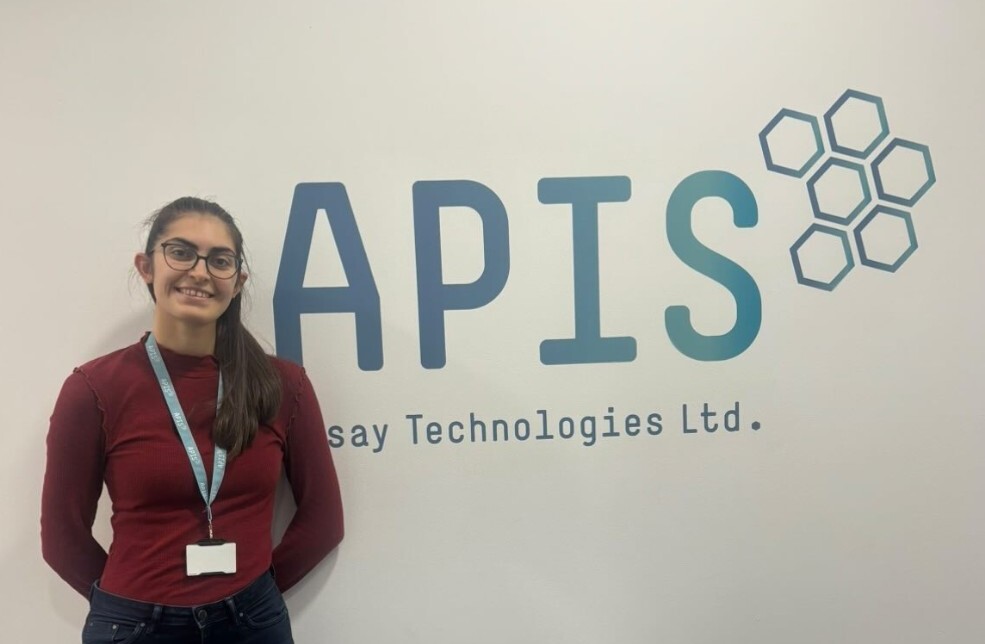
Where did you go and what did you do?
Apis Assay Technologies Ltd is a medium-sized Biotech company whose main line of work is in internal and contract development of qPCR-based diagnostic assays, as well as bioinformatic services. I was based at their headquarters in central Manchester, but the company also has a site in Belgrade (Serbia). I worked as a technical assistant in the contract development team. My work was predominantly lab-based, and involved planning, carrying out and reporting on the outcome of studies for an external client.
What made you want to do that particular PIPS?
I really enjoy bench work, so I knew that I wanted to stay in a lab-based environment, but I’ve not had any experience outside of academia, so I took this opportunity to apply my background in molecular biology to a new setting, and explore the differences between academia and industry, to see how well I could adapt. I have also never had to commute to work, so I thought I could use the placement as a trial period, to see how feasible commuting could be in the long term.
What skills have you gained from your PIPS?
In terms of technical lab skills, the main new technique that I learned was digital PCR, which can provide absolute quantification of nucleic acids in a PCR reaction. I was also exposed to the level of quality control processes in industry compared to academia, which I think is difficult to appreciate without directly being involved in its implementation. Outside of the lab, this placement exposed me to a wide array of writing styles, such as health and safety documentation, protocol and report writing. Whilst I gained many new skills on this placement, it also made me recognise how many transferable skills I had already gained through my PhD, by giving me an opportunity to put them into practice. In my opinion, this was equally, if not more valuable a lesson to learn.
What has been the impact (or likely future impact) of your PIPS?
Having the opportunity to experience technical work in an industrial setting has broadened my options in the future. I now have a better idea of the similarities between equivalent jobs in academia and industry, which will help me when applying to jobs and catering my CV towards jobs in industry. I also n have a greater appreciation for what it takes to be a regular commuter and considerations involved when deciding where to work and live.
How would you sum up your PIPS experience?
Overall, I had a brilliant experience at Apis! The company culture was very encouraging, respectful and understanding of individual needs. I felt very well supported by the team. Effort was clearly made for interns to make the most out of our time there and to shape the experience according to our interests. I would definitely recommend undertaking a placement at Apis.
What advice would you give to other PGRs about PIPS?
I have three pieces of PIPs advice for PGRs:
- There won’t ever be a “right time” in your PhD to do PIPs, so start your search sooner rather than later for maximum flexibility.
- Immerse yourself in the lifestyle and opportunities that come with the job – this is your chance to walk a mile in someone else’s shoes!
- Keep a diary of your experience, including what you’ve enjoyed or found challenging. It’ll help when it comes to reflecting on your time there – and beyond!