Random42 Science Communication – Apply anytime

Random42 Scientific Communications Internship

Random42 provides digital scientific communication solutions to the pharmaceutical and biotech industries, and we have an in-house team of PhD level scientists who work on content and client management. Random42 consists of scientists, artists, animators and programmers, who collaborate to effortlessly intertwine the worlds of science, art and technology, producing some of the most impactful scientific imagery, stories and interactive experiences.

Find out more here: https://random42.com/

See also the blog post written by our recent PIPS interns:

Sarah Stevenson (nee Gratton)

What you will do

The PIPS intern would join our medical team to work on the following areas day to day:

  • Researching background information for new projects
  • Drafting short scripts – This involves putting together a word document that includes the narration and a description of the visuals to be paired up with the voice-over
  • Referencing scripts (each statement must be backed up by recent publications)
  • Putting together reference packs and adding annotations to storyboards
  • Sitting in on client calls to gain live-feedback on scripts and project progress
  • Making script/reference amends as requested by clients
  • Researching specific protein structures via the Protein Data Bank and drug molecules via Pubchem, to ensure a high level of scientific accuracy in projects
  • Putting together storyboards to brief to our production team
  • Spend time with our Production Director to see the process of modelling various structures, and how these are then turned into a scene and animated
  • Gain an understanding of the whole project process, from script to voice over recording, animation and delivery of the final video

Benefits to the student

  • Client management skills
  • Writing skills for different audiences
    Working with creatives
  • Digital asset approval processes
  • Quality checking
  • Brief writing and presenting

Benefits to the company

Previous interns have had a huge impact on projects, helping push them to completion in time for deadlines, checking quality and scientific accuracy, gathering background information and helping to form storylines. In short, they become one of the team!

Details

Where: 114-116 Marylebone Lane, London, W1U 2HH, UK

Contact: Eleanor Spreckley, email: [email protected]

How to apply

Please email [email protected] with your CV and a covering letter explaining why you are interested at working at R42.

Deadline for applications

Interested students can apply at any time.  However, this is a popular internship so applications are encouraged to apply ASAP.

QIAGEN – Manchester – Apply anytime

Overview

QIAGEN is the leading global provider of Sample to Insight solutions to transform biological materials into valuable molecular insights. QIAGEN sample technologies isolate and process DNA, RNA and proteins from blood, tissue and other materials. Assay technologies make these biomolecules visible and ready for analysis. Bioinformatics software and knowledge bases interpret data to report relevant, actionable insights. Automation solutions tie these together in seamless and cost-effective molecular testing workflows. QIAGEN provides these workflows to more
than 500,000 customers around the world.

QIAGEN employ approximately 6,000 people in over 35 locations worldwide. Our mission is to make improvements in life possible by enabling our customers to achieve outstanding success and breakthroughs in life sciences, applied testing, pharma and molecular diagnostics.

Our commitment to the markets, customers and patients we serve drives our innovation and investment in all areas where our Sample to Insight technologies are required. The exceptional talent, skill and passion of our employees are key to QIAGEN’s excellence, success and value.

Project Outline

At QIAGEN Manchester we focus on delivering solutions which facilitate personalised healthcare. You will join a
highly motivated team working on developing Molecular Diagnostic PCR-based assays

Key responsibilities:

  • Design, plan and perform studies for individual research project to support the development of new
    diagnostic products
  • Ensure that experiments are completed to the required quality and regulatory standards
  • Analyse and present results in written reports
  • Work as part of the product development team to ensure a safe and efficient laboratory environment

Requirements

  • University degree and currently completing a PhD in a relevant field
  • Experience in molecular biology (e.g. PCR, RT-PCR, primer design, dPCR, NGS)
  • Good analytical skills and attention to detail
  • Planning and problem solving
  • Positive attitude and self-motivated

Skills developed during placement

  • Work experience in a professional environment
  • Experience in new molecular biology techniques
  • Day to day work following quality and regulatory standards

Number of placements offered: Two placements per intake

Possible Timeframe: Expected intakes are September, January and May, for a minimum period of 12 weeks

Submit your application (CV & cover letter) to the following contacts at QIAGEN (please include the following in email subject: PhD placement – “your name”)

Brandon Foster ([email protected]
James Curran ([email protected])

MORF coding – Apply anytime

MORF is a web-based platform for storing, sharing and interrogating multi-omics data. It was custom built in the Thomas group at York as part of the DETOX project, for which it is a key resource for analysing and disseminating project data. MORF is now being developed as a service for academics and industry to use for their own data, either for their own primary analysis and use or for data dissemination through publications and other routes.

We are looking for a PIPS intern with a strong interest in programming to work in the MORF team, developing the platform and delivering MORF projects for clients. As well as having the chance to put their coding skills to the test, the intern will join the exciting journey to commercialise MORF!

Candidate requirements

Essential:

  • Experience of programming with Python and R.
  • BSc in biology or a related subject
  • Excellent communication skills

Desirable

  • Web development with JavaScript
  • Good knowledge of ‘omics technologies and microbiology

Placement

This opportunity is expected to be fulfilled remotely by a candidate with access to their own computer and internet, supported by in person meetings in York with the MORF team. The candidate will develop their coding skills and apply this to data visualization, integration and analysis problems to help improve the functionality of the tool. Experience in teamwork, time management and customer facing communication will be gained. There may also be opportunities to contribute to publications in this role.

Application Details

Please contact MORF Business Manager Joyce Bennett for informal enquiries and to submit your application and cover letter: [email protected]

Azotic Technologies – Apply anytime

Azotic Technologies Ltd is an innovative Biotech company specialising in the development and commercialisation of novel microbial biostimulants for the agricultural sector.

We are a global leader in Biological Nitrogen-Fixation (BNF) and are currently expanding our
commercial microbial product portfolio into markets in the US, Canada, Europe and Asia. Our
products provide fixed nitrogen across all crops, resulting in enhanced yield and plant health, savings on nitrogen fertiliser while reducing the environmental impact of intensive crop production.

With sites in the UK, Canada and North America, we are a rapidly developing company with a unique product portfolio and an exciting product pipeline beyond Nitrogen-fixation.

Azotic is currently embarking on an expansion program to meet our global objectives. This expansion includes significant growth in our global team and a substantial investment in our technical and operational infrastructure. We have recently moved into our bespoke Technical Development Centre in Dunnington, York housing up to 30 scientific and administrative employees.

We are looking for motivated and enthusiastic people to join us on our exciting journey to enhance global food security.

Project Outline

You will be working in a highly skilled team investigating the effects of Gluconacetobacter diazotrophicus (Gd) and designed consortia of microorganisms on main crops and horticultural
crops, aimed at addressing challenges posed by global warming and to reduce the use of pesticides.

Key Responsibilities

  • Design, plan and perform studies to support the development of new products
  • Ensure that experiments are completed to the required quality and regulatory standards
  • Analyse and present results in written reports
  • Work as part of the product development team to ensure a safe and efficient laboratory
    environment

Skills developed during placement

  • Work experience in a professional environment
  • Multi-disciplinary skills in Biotechnology
  • Day to day work following quality and regulatory standards
  • Entrepreneurial skills

Requirements

  • University degree and currently completing a PhD in a relevant field
  • Experience in microbiology, biochemistry or plant physiology
  • Good analytical skills and attention to detail
  • Positive attitude and self-motivated

Contact: [email protected]

If needed, the host organisation is willing to provide additional funding for accommodation and travel.  If you are not sure how to approach this, please consult your local PIPS Contact.

Future bioscientists come together for launch of Yorkshire doctoral training partnership

Nine institutions across Yorkshire and Teesside have welcomed the first PhD students to the BBSRC-funded Yorkshire Bioscience Doctoral Training Partnership.

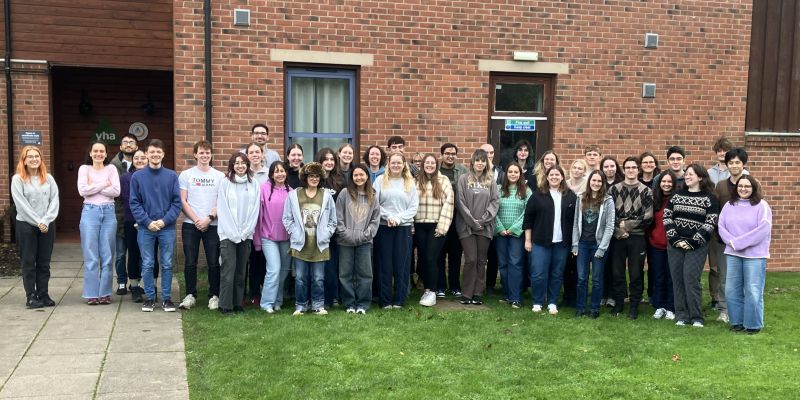
Image: The first cohort of PhD students at the YBDTP residential.

Launched this autumn, the Yorkshire Bioscience Doctoral Training Partnership (YBDTP) is a new collaboration which will deliver doctoral training to support the UK bioeconomy. It is a partnership of nine universities: the University of Leeds, the University of Sheffield, the University of York, Leeds Beckett University, Sheffield Hallam University, Teesside University, the University of Bradford, the University of Huddersfield and the University of Hull.

It has been established to train the bioscience researchers of the future, helping to make sure they are fully equipped to address fundamental and strategic biological questions of national and global importance.

Building on the success of the previous White Rose Doctoral Training Partnership in Mechanistic Biology, the collaboration has attracted investment from the Biotechnology and Biological Sciences Research Council (BBSRC) and from the partner institutions.

The partnership will offer cutting-edge research projects in bioscience and biotechnology, complemented by an interdisciplinary training programme and professional placements to give students the variety of skills needed for the UK bioeconomy.

Building a community

The first cohort of PhD students recently attended a multi-day induction event at the YHA National Forest in Derbyshire, which provided training and opportunities to build networks across the partnership.

Training was delivered by representatives from the University of Leeds, Sheffield Hallam University and the University of York and focused on some of the key elements of PhD research, including:

  • the nature and expectations of PhD research training
  • experimental design and data generation for publication
  • effective project and time management.

Professor Jo Clarke from Petros, a not-for-profit organisation focused on resilience and wellbeing, also delivered a resilience training session which was well received by the students.

During the residential, students also had the opportunity to play an active role in shaping the future of the partnership, taking part in creative workshop sessions to explore the development of YBDTP’s identity as well as team-building activities that enabled them to explore their own research projects and build connections with their peers.

YBDTP PhD student El Cholmondeley said:

“There was a very big sense of community, and it was inspiring to be in a room full of people who are so passionate. It prompted me to think about the bigger picture of my PhD.”

Putting students at the heart of the partnership

Dr Eric Hewitt, Interim Director of the YBDTP and Associate Professor in the Faculty of Biological Sciences at the University of Leeds, said:

“The students really are at the heart of the YBDTP, and their involvement in helping to shape the partnership’s identity and ethos from the outset reflects this commitment. We’re really looking forward to supporting these students on their PhD journeys and welcoming a new cohort in 2026.”

This collaboration provides an excellent opportunity for our doctoral researchers to develop research networks spanning nine universities, as well as with key industry partners.

Further information

Applications for entry to projects for 2026 are now open. Find out more, including how to apply.